
Evaluation and Review
What is Evaluation?
Evaluation is the systematic and objective assessment of a program, project, or policy. It plays a key role in decision-making by providing evidence on whether an initiative is:
Relevant – Is the right problem being addressed, and is the intervention appropriate?
Effective – Are the intended objectives and outcomes being achieved?
Efficient – Are outcomes being delivered in a cost-effective way?
Impactful – Is the intervention making a meaningful difference, and for whom?
Sustainable – Are outcomes likely to be maintained over time?
In practice, a mix of process, outcome (impact), and economic evaluation helps tell the full story, what was delivered, what changed, and whether the investment represented value for money.
Types of Evaluation
A typical evaluation draws on three complementary types of evaluation: process, outcome (impact), and economic evaluation:
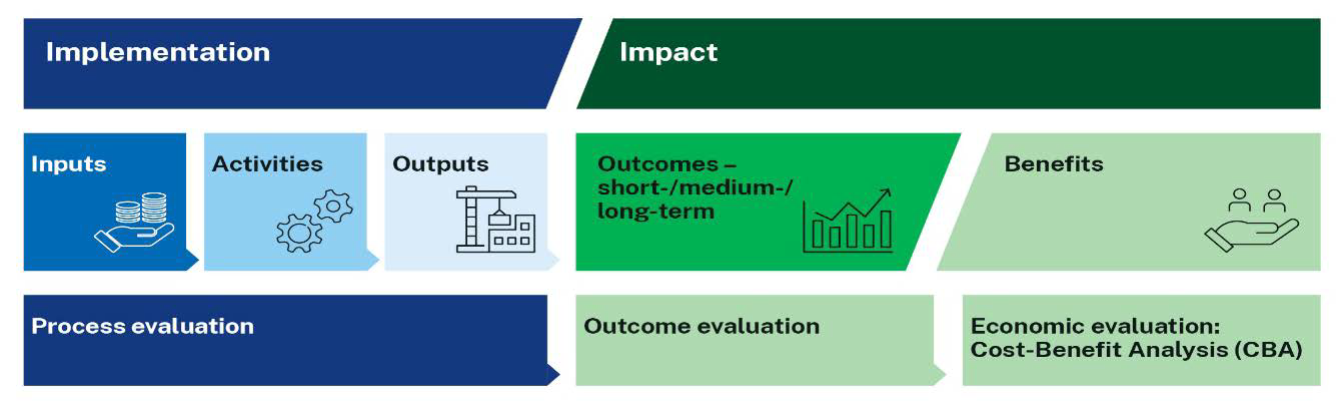
Types of evaluation relevant at different stages of initiative implementation (source: NSW Treasury, Policy and Guidelines: Evaluation TPG22-22)
Process evaluation examines implementation and delivery. Is the intervention being implemented as intended? Is the program design working in practice? What is working, for whom, and why?
Outcome evaluation (or impact evaluation) assesses what has changed as a result of the intervention. What outcomes have occurred, and for which groups? To what extent can these changes be attributed to the intervention (rather than other factors)? How large are the effects, and do they differ across cohorts, locations, or settings?
Economic evaluation assesses value for money by comparing the costs incurred in delivering the intervention with the outcomes attributable to it. What was the cost per attributable outcome achieved (cost-effectiveness or cost-utility analysis), and, where outcomes can be credibly valued in monetary terms, what was the net social benefit (cost-benefit analysis)?
Reviews
Reviews provide a rapid, targeted appraisal of a program, project, or policy. They are typically used to:
Check progress and identify practical improvements.
Gather timely evidence to support decisions, such as whether to continue, adjust, scale, or stop an initiative..
Planning or Commissioning Evaluations
If you are planning or commissioning an evaluation or review, our Resources for Evaluation and Review provide practical guidance to help you scope the right approach.
Our Evaluation and Review Services
Inform Economics offers:
Economic evaluation
Cost-effectiveness analysis
Value for money reviews
Impact assessment and economic impact analysis
Impact assessment
Reviews and diagnostics
Agency and program reviews
Post-implementation reviews
Evaluation design and measurement
Planning data collection before implementation
Benefits database development
Benefits realisation
Capability building
Training and capability building, including workshops delivered for the Australian Evaluation Society, governments, and not-for-profits.
Would you like to discuss tailored evaluation support?
Examples of our recent work include:
NSW Department of Communities and Justice | Future Directions for Social Housing in NSW: Service Improvement Initiatives | Outcomes and Economic Evaluation (2020-2023)

Future Directions for Social Housing in NSW
Future Directions for Social Housing in NSW sets out the NSW Government’s vision for social housing from 2016 to 2025. That vision is underpinned by three strategic priorities:
More social housing.
More opportunities, support and incentives to avoid and/or leave social housing.
A better social housing experience.
As part of an evaluation consortium, Inform Economics conducted the economic evaluation (cost-benefit analysis) of three Service Improvement Initiatives that were implemented as part of Future Directions:
Rent Choice - a private rental subsidy supporting access to safe and affordable housing for eligible people who can show that they're able to sustain a tenancy in the private rental market.
Opportunity Pathways - support for people receiving social housing assistance to access education, training and work.
Youth Development Scholarships - supporting students studying in Year 10, 11 or 12 in NSW, who are either social housing clients or living in out-of-home care, with $1,000 to help with school expenses and secondary support services.
Each of our cost-benefit analyses drew on the outcomes identified from the analysis of linked administrative data, together with estimates of future costs and benefits.
The results of our cost-benefit analyses can be found in the Final Evaluation Report with the more detailed analysis in the Appendices.
NSW Department of Planning and Environment | Evaluation of Fast-Tracked Assessment Program
The new Tweed Valley Hospital development is an example of one the major projects selected for fast-tracking (Tranche 2).
The Fast-Tracked Assessment Program (the Program) was established at the beginning of the COVID-19 pandemic to accelerate the assessment and determination of ‘shovel ready’ projects that would inject investment into the NSW economy and keep people in jobs during and after the COVID-19 pandemic.
The program included projects that required State planning approval such as State Significant Developments, State Significant Infrastructure, major projects, and planning proposals.
101 projects were selected for fast-tracking with the potential for 50,000 jobs, 25,000 new dwellings, investment value of $25 billion, and 400 hectares of open space.
We undertook an evaluation of the Program which focused on the costs, benefits and outcomes.
NSW National Parks and Wildlife Service (NPWS) manages 893 NSW national parks and reserves, covering over 7 million hectares of land.
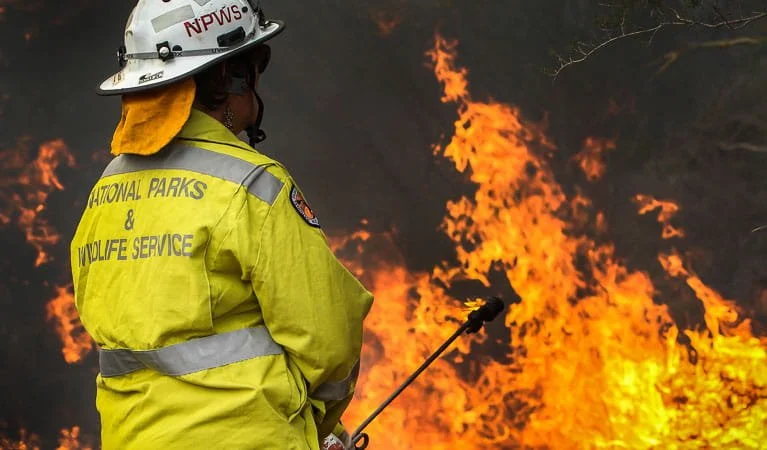
Hazard reduction work being undertaken by NSW National Parks and Wildlife Service.
The Enhanced Bushfire Management Program supports work to improve bushfire response, increase hazard reduction and develop research to reduce the risk of bushfire across New South Wales.
As part of an evaluation consortium, we undertook the ex-post economic component of the summative evaluation of the Enhanced Bushfire Management Program 2017-2022 and made recommendations for enhancing economic evaluation in the next phase of the program.
For more information about NPWS and its work in managing fire in park and reserves visit NSW NPWS.
Destination NSW | Ex-Post Cost-Benefit Analysis
Destination NSW is the lead government agency for the NSW tourism and major events sectors, influencing and shaping the NSW visitor economy through strategic research, policy and thought leadership, stakeholder engagement and consultation, commercial partnerships, and investment in visitor experiences, business support, marketing, and events.
‘Come and Feel New in Sydney’, an example of one of Destination NSW’s campaigns.
We have undertaken ex-ante and ex-post cost-benefit analyses of investments in marketing campaigns and major events, and helped develop a methodology for undertaking cost-benefit analysis that can be applied to marketing campaigns and major events on either an ex-ante or ex-post basis.
A performance audit of Destination NSW’s support for major events favorably commented that ‘Destination NSW has recently incorporated cost-benefit analysis principles into its event assessment methodology. This approach has the potential to further increase the rigour of event assessment because the cost-benefit analysis methodology considers a range of costs and benefits beyond the direct economic impact’.
NSW Rural Fire Service | Post-Acquisition Financial Analysis of Aviation Assets

This file is licensed under the Creative Commons Attribution-Share Alike 3.0 Australia license.
To inform the NSW Rural Fire Service’s strategic review of its aviation needs, we undertook an independent financial analysis of all acquired aircraft.
Our analysis assessed lifetime costs and benefits, and examined whether acquisition and ownership had delivered value for money.
The NSW Rural Fire Service has since expanded its aviation fleet to eleven aircraft (one Boeing 737 large air tanker, two Cessna Citation lead/intel jets, six Bell-412 helicopters, one CH-47 Chinook helicopter, and one Beechcraft Super King Air).
Achieving ‘value for money’ is the primary consideration in every procurement. However, ‘value for money’ isn’t the same as getting the lowest price. Rather, it means taking a big picture view that compares lifetime costs and benefits, as well as considering fitness for purpose and risk.
Further information and guidance on assessing value for money in procurement can be found here.
Resources for Evaluation and Review
If you are planning or commissioning an evaluation of a program or project, useful resources include:
Evaluation Communities of Practice
Australian Evaluation Society - a member based organisation which exists to improve the theory, practice and use of evaluation in Australia for people involved in evaluation.
Australian Centre for Evaluation (ACE) - established to help put evaluation evidence at the heart of policy design and decision-making. ACE seeks to improve the volume, quality, and use of evaluation evidence to support better policy and programs that improve the lives of Australians.
ACE Evaluation Library - designed to improve access to evaluations of Australian Government programs and services, the library provides policymakers with a central repository of evaluations commissioned or conducted by the Australian Government, and spanning all policy portfolios.
BetterEvaluation - an international collaboration to improve the practice and theory of evaluation.
American Evaluation Association - professional association of evaluators devoted to the application and exploration of evaluation as a profession, and with more than 5,000 members representing all 50 states in the United States as well as more than 80 foreign countries.
European Evaluation Society - promoting the theory, practice, and utilisation of high-quality evaluation in Europe and beyond.
EvalCommunity - a global platform for professionals and organisations working in monitoring and evaluation, supporting networking, knowledge sharing, professional development and career opportunities.
Australian States & Territories Guidance on Evaluation
ACE Guidance on economic evaluation methods (2025) - overview on economic evaluation methods including additional guidance on when and how to use cost-benefit analysis and cost-effectiveness analysis in economic evaluation.
NSW Evaluation Toolkit - a resource designed for NSW public sector managers who are responsible for a program evaluation.
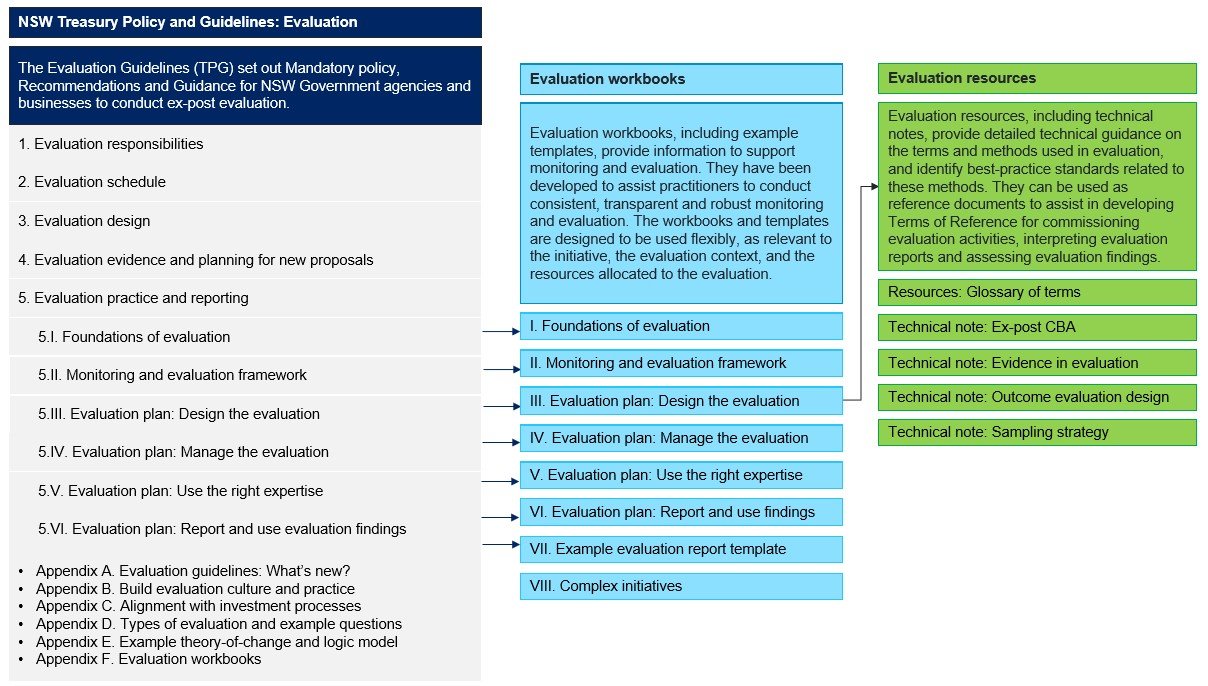
NSW Treasury TPG22-22 Policy and Guidelines: Evaluation (2023) - sets out mandatory requirements, recommendations and guidance for NSW General Government Sector agencies and other government entities to plan for and conduct the evaluation of policies, projects, regulations, and programs. TPG22-22 is supported by online workbooks and resources designed to be used flexibly as relevant to the initiative, the context in which it is being evaluated, and the resources allocated to the evaluation.
NSW Government Guide to Economic Evaluation and Ex-Post CBA for TfNSW Evaluation Programs (2024) - sets out the requirements, process for managing an Economic Evaluation, and high-level guidance for an ex-post CBA, for all suitable projects / programs nominated in the TfNSW Evaluation Schedule.
NSW Government Technical Note on Ex-Post Cost-Benefit Analysis (TPG22-22) - supplementary guidance for undertaking ex-post cost-benefit analysis when an initiative is underway (interim or ‘in media res’ ex-post CBA) or completed (final ex-post CBA) to assess the net social benefits of an implemented initiative.
NSW Government Grants Administration Guide (2022) - provides an overview of the grants administration process in NSW including evaluation requirements.
First Nations Investment Framework TPG24-28 (2024) - a guide to good practice in working with First Nations people and communities on the design, economic appraisal and evaluation of initiatives.
Queensland Government Program Evaluation Guidelines (2020) - broad principles that are expected to underpin the planning and implementation of evaluations for programs funded by the Queensland Government. Includes supplementary information sheet on economic evaluation.
Western Australia Program Evaluation Guide (2020) - a resource developed for Western Australian Government agencies undertaking the evaluation of government funded programs.
Northern Territory Government Program Evaluation Framework and Toolkit (2022) - framework and toolkit to be used by Territory Government agencies to help plan, commission and use evaluations. Also provides useful guidance for Territory Government service delivery partners and external evaluators of Territory Government programs.
ACT Government Evaluation Policy and Guidelines (2010) - a resource designed to support ACT Government agencies in planning for and executing evaluations.
Commonwealth Guidance on Evaluation
Commonwealth Evaluation Policy - a principles-based approach for the conduct of evaluations across the Commonwealth. The policy is supported by the Commonwealth Evaluation Toolkit which provides templates, tools, and other resources, to help plan and conduct an evaluation.
Commonwealth Grants Rules and Principles 2024 - Replacing the previous Commonwealth Grants Rules and Principles 2017, the new CGRPs are designed to improve integrity, accountability and transparency in grants administration, consistent with achieving government policy outcomes and ensuring equitable access of grants to, and for, the benefit of the Australian public.
Australian Government Post-Implementation Reviews (2020) - a guidance note to support Australian Government agencies that need to undertake a post-implementation review of any regulatory changes that have a substantial or widespread impact on the economy. Did the implemented policy operate as intended and is it effectively and efficiently meeting the Government’s objectives in addressing the original problem?
State of Evaluation in the Australian Government 2025 - inaugural report by Australian Centre for Evaluation (ACE) assessing how evaluation is currently used across the Australian Government.
Guidance on Health Evaluations
Planning and Managing Program Evaluations: A Guide (2023) - guide to support NSW Health staff in planning and managing program evaluations.
Engaging an Independent Evaluator for Economic Evaluations: A Guide (2023) - guide to assist NSW Health staff in engaging an independent evaluator for economic evaluations, particularly in relation to population health programs.
Developing and Using Program Logic: A Guide (2023) - guide to support NSW Health staff in the development of program logic and its use in informing population health program planning, implementation, monitoring and evaluation.
Preparing and Appraising Evaluation Reports: A Checklist (2023) - checklist designed to inform evaluators (and those commissioned to evaluate programs) of the expectations for the preparation of evaluation reports, and to provide NSW Health staff with a framework for the appraisal of commissioned reports.
Planning Economic Evaluations: A Checklist (2023) - checklist to assist users across NSW Health to identify and consider all appropriate components when planning an economic evaluation.
Reviewing Economic Evaluations: A Checklist (2023) - checklist is to assist users across NSW Health to systematically review the quality and relevance of economic evaluations.
Study Design for Evaluating Population Health and Health Service Interventions: A Guide (2023) - guide to support NSW Health staff in the planning of evaluations of population health and health service interventions using appropriate study designs.
Consolidated Health Economic Evaluation Reporting (CHEERS) Standards (2013) - a consolidation and update of previous health economic evaluation guidelines efforts into one current, useful reporting guidance. The primary audiences for the CHEERS statement are researchers reporting economic evaluations and the editors and peer reviewers assessing them for publication.
Guidance on Value for Money
Value for Money - NSW Government guidance on assessing value for money in procurement and evaluation.
Value for Money and the 5Es: Designing a context-specific VfM framework - a guide by Julian King on designing context-specific value-for-money frameworks using the 5Es: economy, efficiency, effectiveness, cost-effectiveness, and equity.
Evaluating Methods for Assessing Value for Money (2013) - paper developed by a Working Group convened through the Australian Evaluation Society which provides information on the topic of Value for Money and presents a range of methods for assessing Value for Money.
International Guidance on Evaluation
UK Government: The Magenta Book (2026) - provides guidance on how to incorporate evaluation through the design, implementation, delivery and review stages of policy making. This 2026 update, the first since 2020, introduces several new and significantly expanded areas of focus to support high-quality evaluation across government, including Value for Money, Test and Learn, Evaluation and Benefits Management, Research Transparency, AI in evaluation and Place-Based Evaluation.
New Zealand Government: making sense of evaluation: A handbook for everyone (2017) - this practical, introductory handbook is designed for people new to evaluation. It explains core evaluation concepts and processes in clear, non-technical language, helping users understand whether a programme is working, for whom and why.
Evaluation in the Government of Canada - requirements for evaluation in the Government of Canada are outlined in the following: Policy on Results, Directive on Results, Mandatory Procedures for Evaluations, and the Standards for Evaluation.
Guidance on Impact Assessment/Evaluation
CSIRO: Impact Evaluation Guide (2020) - articulates a common framework for all CSIRO impact evaluations. The Guide has been publicly released as CSIRO believes that it is beneficial for the broader innovation system for Australia’s publicly funded research organisations to use a common approach to the assessment of the outcomes and impacts of their research.
ACIAR: Guidelines for assessing the impacts of ACIAR's research activities (2008) - provides a common approach for making three types of assessment of the impact of ACIAR investments - quick assessment of expected impact, adoption studies (observed and anticipated impacts), and full impact assessments. ACIAR has a long history of undertaking impact assessments. It’s well-designed frameworks and approach can be applied more widely to other research activities.
Guidance on Process Evaluation
Australian Institute of Family Studies: Process evaluation (2025) - this guide explains why process evaluations are useful and outlines the key steps involved in doing one. Each step offers practical information for how to plan and execute a process evaluation, with examples and tools to help apply the guidance in this resource.
Wellbeing Frameworks & Outcome Budgeting
Australian Government: Measuring What Matters (2023) - Australia’s first ever national wellbeing framework which sets out the factors that are important to Australians’ individual and collective wellbeing across all phases of life in five broad themes – healthy, secure, sustainable, cohesive and prosperous.
NSW Government TPP18-09 Outcome Budgeting (2018) - provides guidance on the first two elements of the Outcome Budgeting Framework (i) developing and maintaining outcome structures and (ii) financial and non-financial requirements for performance reporting purposes.
Research Sources
Australian Institute of Family Studies - Australian Government statutory agency established in 1980 under the Family Law Act 1975 with a mission is to conduct high-quality, impartial research into the wellbeing of Australian families, to inform government policy and promote evidence-based practice in the family services sector. Also incorporates the Australian Gambling Research Centre (AGRC), which was established under the Gambling Measures Act 2012.
APO (Australian Policy Online) - an open access evidence platform, making public policy research and resources accessible and usable.
Office of Evaluation Sciences (US) - an interdisciplinary team within the U.S. General Services Administration that partners with federal agencies to conduct rigorous evaluations, build evidence, and improve government programs and services through data-driven decision-making. Since 2015, OES has completed over 100 collaborations across various government agencies. The OES website includes many valuable resources to those planning or conducting evaluations.