
Business Case Development
We develop business cases for government programs and investments, providing a clear, evidence-based case for funding and policy decisions. Our work combines rigorous economic analysis with a strong commercial focus, ensuring proposals are robust, credible and able to inform decisions.
What is a Business Case?
A business case provides the information and analysis needed to inform an investment decision. It is a structured, evidence-based assessment of an investment proposal that defines the case for change, evaluates alternative options, and assesses value for money, financial feasibility and deliverability.
Why is a Well-Developed Business Case Important?
A well-developed business case demonstrates that an initiative is justified, delivers value for money, and is financially and commercially viable. It supports transparent decision-making, helps secure funding and approval, and provides a sound basis for implementation.
Our Approach
We follow a structured approach, working through each stage of the business case development process:
Establishing the Case for Change (Go/No-Go)
We confirm the need for change, assess strategic alignment, and identify expected benefits, providing a clear basis for deciding whether to proceed.Identifying and Analyzing Options (Preliminary Business Case)
We explore a comprehensive range of options and assess them using cost-benefit analysis and financial appraisal, producing a refined shortlist of viable options.Selecting the Preferred Option and Planning Implementation (Full Business Case)
We prepare the preferred option for decision and implementation, including detailed cost-benefit and financial analysis, procurement and risk planning, and a benefits realisation framework.Proportionate Pathways
For smaller or lower-risk proposals, we also deliver Lean Business Cases and Short-Form Assessments, ensuring requirements are met without unnecessary complexity.
For government clients, all business cases are developed in line with relevant business case guidelines and consistent with gateway assurance processes.
Our Expertise
Our team brings specialist expertise across all stages of business case development:
Facilitation and Stakeholder Engagement
We coordinate stakeholder engagement throughout the business case process, aligning interests and building consensus.
Cost-Benefit Analysis and Financial Appraisal
We undertake rigorous economic and financial analysis to assess value for money and financial feasibility.
Commercial and Management Analysis
We support procurement strategy, risk management and operational planning, helping establish practical and effective implementation arrangements.
Benefits Realization and Performance Management
We set measurable objectives and create monitoring frameworks to track outcomes and support benefits realisation.
Resources for Developing Business Cases
If you are planning the development of a business case, see our selection of useful resources for developing business cases.
Business Case Training and Capability Building
In addition to developing business cases, we provide tailored training and capability-building services in business case development. Our workshops, delivered in-house or publicly, in person or virtually, equip participants with practical skills and knowledge for preparing effective business cases. Recent workshops have included Cost-Benefit Analysis for Business Cases, designed for NSW Government agencies implementing the NSW Government Business Case Guidelines TPG24-29.
Ready to Get Started?
Contact us to discuss your project or training needs.
Examples of our Business Case Development Work
NSW Government | OneCX program

OneCX program aims to create a unified and customer-centric experience of NSW Government
In 2019, a review identified more than 1,000 NSW Government websites on 35 different content management systems.
The review highlighted that government could:
create a better digital experience through consistent design, content and style
find cost efficiencies by reducing unnecessary duplication of functionality.
As a result, the NSW Government Digital Channels team developed the OneCX program to create a unified and customer-centric digital experience for people in NSW, making it easier for people in NSW to:
complete specific tasks online in fewer clicks on fewer websites or in less time
find consistent information through search or by browsing customer-centric topics on one website
voice their opinion on what the government is doing through a central channel.
As more content is published on nsw.gov.au, there will be fewer websites centred around the structure of government. Instead, digital information, services and transactions are now being organised by customer-centred topics on:
the nsw.gov.au website for information
the Service NSW website for services and transactions.
Through 2020, we supported the NSW Government Digital Channels team to develop their detailed business case (including cost-benefit analysis) and to progress through Gateway review processes. This was all done whilst the Digital Channels team were preparing to launch the nsw.gov.au beta site and then delivering a whole of government digital communications response to the COVID-19 pandemic.
As the OneCX Program is progressively rolled out, it’s making it easier for customers to access the information they need, without having to understand or navigate the structure of government. Around 2.74 million people are visiting nsw.gov.au each month and, at the end of 2025, more than 190 websites have been migrated and/or decommissioned.
Learn more about the OneCX Program, including the OneCX Program Blog and month-by-month timeline of progress and achievements.
NSW Environment Protection Authority - Asbestos Coordination, Clean-Up, and Awareness Initiative

Safe removal of asbestos
Australia’s widespread use of asbestos during the twentieth century (from 1930s to 1980s), and its history of mining and producing asbestos since the 1900s, has left an asbestos legacy across NSW, in both the built and natural environment, that will need to be managed for many years to prevent asbestos-related disease in the state.
In 2015, there were an estimated 4,152 deaths in Australia due to asbestos-related disease[1] – more than 3-times the number of fatalities on Australian roads in the same period (2015: 1,209[2]).
NSW Environment Protection Authority led the development of a proposed 4-year initiative to help prevent asbestos-related disease in the state through the improved safe management of legacy asbestos and more comprehensive asbestos education and awareness.
We supported the funding submission through the development and preparation of a business case, including cost-benefit analysis. The submission was successful with funding commencing in 2018/19.
[1] Australian Government, Asbestos Safety and Eradication Agency, National Asbestos Profile for Australia, November 2017
[2] Australian Government, Department of Infrastructure and Regional Development, Bureau of Infrastructure, Transport and Regional Economics, December 2015
Resources for Developing Business Cases
If you are planning the development of a business case, useful resources include:
Commonwealth Government Guidance on Business Cases
Commonwealth Investment Framework (RMG 308) - overview of the policy and best practice guidance for Commonwealth entities to consider when developing, implementing and managing investment proposals. This includes guidance on Investment Proposal & Business Case Development and a series of Toolkits to support the development of investment proposals and business cases. The Toolkits include:
Developing a Business Case - the essential elements of a business case (modified from Infrastructure Australia guidance for application in a broader range of policy proposals).
Guidance for Financial Modelling - key elements of a financial model.
Cost Estimation - guidance on cost estimation for major projects.
Commonwealth Government Digital and ICT Investment Approval Process - assists entities to develop robust business cases and support the effective implementation of digital and ICT-enabled proposals. Key steps include:
First Pass Approval - first pass business case will provide a sufficient level of information on the benefits, costs, risks and range of digital and ICT implementation options for a proposal to enable an informed in-principle decision on the investment. Template downloadable here.
Second Pass Approval - second pass business case will contain risk mitigation strategies, detailed cost estimates, appropriate funding options and provide assurance that the planning, consideration and consultation required for successful implementation has been undertaken.
Available resources Includes Department of Finance ICT Business Case Guide, First Pass Business Case Template and Second Pass Business Case Template.

Overview of Infrastructure Australia Assessment Framework (2021)
Infrastructure Australia Guidance on Business Cases
Infrastructure Australia Assessment Framework (2021) - guidance on the new four-stage process for developing high-quality infrastructure proposals for submission to Infrastructure Australia including:
Stage 1 submission template and checklists for each of Stages 2, 3 and 4.
Detailed supporting technical guidelines:
Guide to program appraisal (new)
Guide to multi-criteria analysis (new)
Guide to economic appraisal (updated)
Guide to risk and uncertainty analysis (updated)
NSW Government Guidance on Business Cases
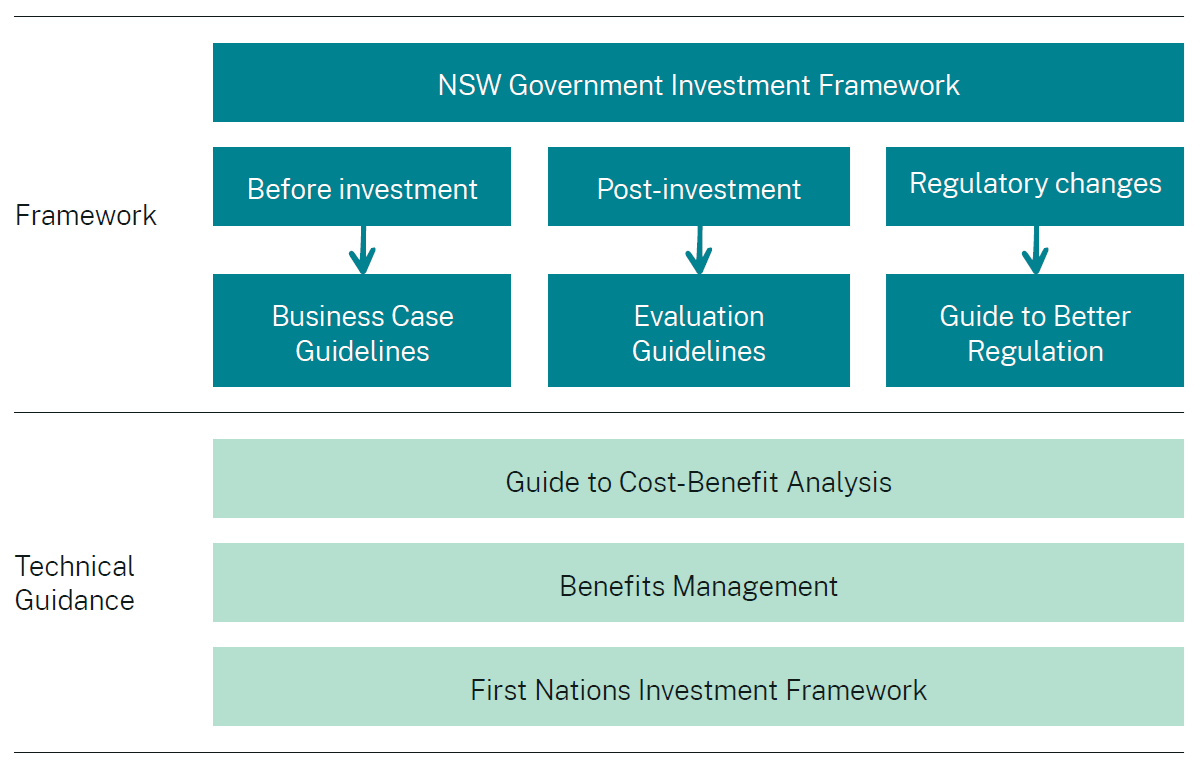
NSW Government Investment Framework

NSW Government Business Case Guidelines - Types of Business Cases

NSW Government Business Case Guidelines - Components of a Business Case
Business Case Guidelines (TPG24-29) - set out the mandatory requirements and provide guidance to assist agencies in preparing business cases. This latest update simplifies the structure, process, and content compared with the previous Business Case Guidelines (TPP18-06).
Gateway Policy (TPG22-12) - provides guidance and core requirements for the delivery and monitoring of Gateway reviews in NSW. It sets out the requirements that the Gateway Co-ordination Agencies (GCAs), the Delivery Agencies, and the Policy Owner must follow. The GCAs are:
Infrastructure NSW which administers the Infrastructure Investment Assurance Framework (updated 2024)
Department of Customer Service which administers the Digital Assurance Framework (updated 2024)
NSW Treasury which administers the Recurrent Expenditure Assurance Framework (TPG24-24)
Carbon Emissions in the Investment Framework (TPG24-34) - sets out requirements for carbon emissions, including the carbon values that NSW agencies must use in cost-benefit analysis.
Fast Track Business Case and Investment Assurance (TPG24-30) - establishes criteria and a process to seek full or partial exemptions from business case and assurance requirements in limited circumstances.
Benefits Management Guide (TPG24-31) - provides guidance on benefit management, the process of identifying, organising, managing, measuring and reporting benefits so that intended benefits of an initiative are monitored and achieved.
First Nations Investment Framework (TPG24-28) - guide to good practice in working with First Nations people and communities on the design, economic appraisal and evaluation of initiatives.
Gender Impact Assessment Policy (TPG23-27) - provides guidance to general government sector agencies on when and how to complete gender impact assessments for new policy proposals.
Management of Contingency Provisions for Major Projects (TC14-29) - sets out requirements for management of contingency provisions across the project life cycle of major projects.
Infrastructure NSW Business Case Summary - template and guidance for developing an Infrastructure Business Case Summary.
Other Australian State & Territory Guidance on Business Cases

Overview of Queensland Government Business Case Development Framework
Queensland Government Business Case Development Framework - guides business case investment proposals through the three stages of (1) Strategic Assessment, (2) Options Analysis and (3) Detailed Business Case.
Victorian Government Business Case Guidance - templates and technical supplements in support of the business case stage for infrastructure investment.
Victoria Government (Developing ICT Investments) - provides technical guidance and assistance in developing business cases for ICT projects.
South Australian Government Guidelines for the Evaluation of Public Sector Initiatives (Part A) - overview of the investment evaluation framework.
Western Australian Government Business Case Template - template to support business case development for agencies planning to purchase goods and/or services that are likely to be high-risk, high-value or of a unique nature.
Tasmanian Government Structured Infrastructure Investment Review Process - overview of review process and guidance for Investment Concept and Options Analysis, and for development of Business Case.
Northern Territory Government Strategic Business Case Template - template for development of strategic business cases in the Northern Territory.
UK and New Zealand Guidance on Business Cases & Benefits Management
United Kingdom HM Treasury - Guidance on Developing Business Cases for Projects and Programmes (2026) - guidance setting out the step-by-step process for developing business cases for projects and programs, based on the Five Case Model.
United Kingdom Guide for Effective Benefits Management in Major Projects (2017) - key benefits management principles and activities when delivering major projects.
New Zealand Government Better Business Cases (2026) - in March 2026, the Treasury released a refreshed suite of Better Business Case templates and guidance for project and programme business cases. The refresh is designed to produce more fit-for-purpose business cases, reduce unnecessary time and effort, and ensure decision-makers have the key information needed at each stage of the investment lifecycle.
New Zealand Treasury Managing Benefits from Projects and Programmes: Guide for Practitioners (2024) - provides high-level guidance on benefits management that aligns with New Zealand’s Better Business Case framework and is applicable to projects and programmes across the public sector, and more broadly in other sectors.